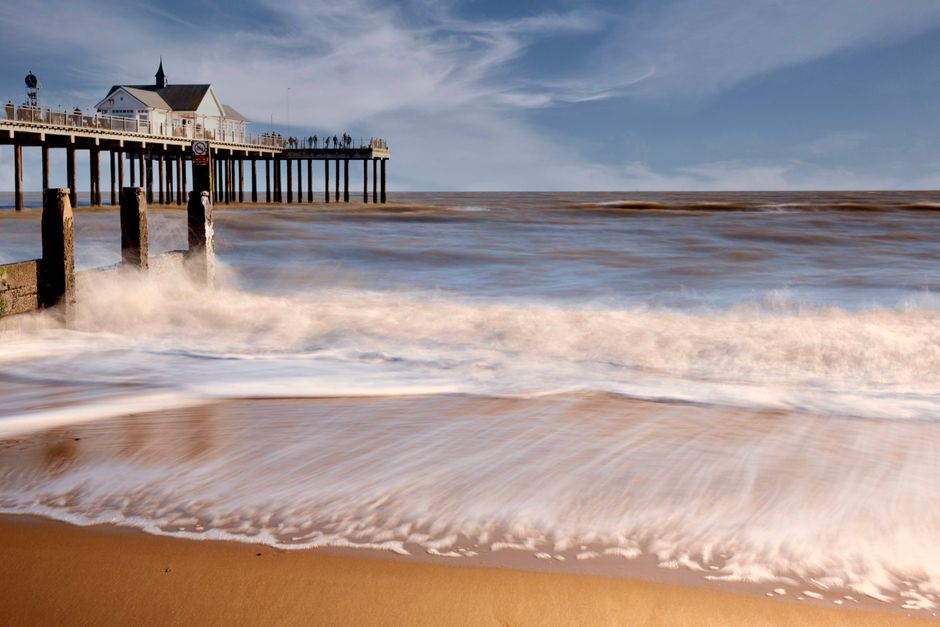
- Southwold Pier is in Suffolk, England.
- Check access, weather and local guidance before travelling.
About Southwold Pier
Southwold Pier is a charming, independently owned pier on the Suffolk coast, shorter than its Victorian peers but full of character with amusement arcades, a café and quirky attractions. It has a devoted following for its nostalgic, slightly eccentric atmosphere.
The story of Southwold Pier
The original Southwold Pier was opened in 1900, built by the Southwold Pier and Promenade Company as an excursion pier for paddle steamers. At its peak it extended 810 feet but was gradually reduced in length after storm damage, with sections lost in 1934, 1955 and 1978. The pier fell into serious disrepair until it was rescued in 1999 by pier owner Chris Iredale, who undertook a substantial restoration, rebuilding the pier to a shorter 623 feet with new pavilions. The pier's famous Under the Pier Show, featuring bizarre handmade automata by Tim Hunkin, opened in 2005.
Visiting with care
Open year-round, the pier is small enough to stroll in minutes but rewards a longer visit for the unique Under the Pier Show, a collection of surreal handmade machines. Southwold itself is a genteel town famous for Adnams beer, so pair the pier with a brewery visit.
Interesting facts
- The original 1900 pier extended 810 feet but was shortened by repeated storm damage.
- Rescued from dereliction in 1999 and rebuilt to its current 623 feet.
- Home to the Under the Pier Show, handmade automata by engineer Tim Hunkin.
- One of the few piers in England still independently owned.
Getting there
Parking and access details — check locally for the latest information.